EV tyres are built for heavier cars with instant torque and silent drivetrains: they have a higher load capacity (XL or HL), low rolling resistance to protect range, tougher compounds against torque wear, and often foam inside to cut road noise. You can fit a non-EV tyre if the size, load index and speed rating match, but expect more noise, faster wear or reduced range.
Why EV tyres exist at all
The first time I changed tyres on a Tesla Model Y, two things struck me: how heavy the wheel assemblies felt, and how worn the rears were at just over 25,000 km. That's typical. Electric cars put tyres through a different kind of work, and tyre makers now design EV tyres specifically for it.
Three things drive the difference: weight, torque and silence. Battery packs typically add hundreds of kilograms compared with a similar petrol car. Electric motors deliver full torque from standstill. And with no engine noise, you hear the tyres much more.
What makes an EV tyre different
Not every manufacturer uses every feature, but these are the ones you'll see on EV-specific tyres.
| Feature | Why it's there | How you spot it |
|---|---|---|
| Higher load capacity (XL or HL) | Carry the battery's extra weight | XL marking or HL before the size; higher load index |
| Low rolling resistance compound | Every bit of resistance costs range | EU-style label, brand EV branding |
| Tougher, torque-resistant tread | Resist wear from instant acceleration | Usually marketed, not marked |
| Acoustic foam inside | Cut cavity noise that an EV makes obvious | Michelin Acoustic, Pirelli PNCS, Continental ContiSilent, Goodyear SoundComfort and similar |
| Car-maker approval marking | Developed to the car's spec | T0 / T1 for Tesla, other OE codes for other brands |
Load index and HL tyres on EVs
This is where I'd be most careful. Many EVs, especially larger SUVs, specify XL tyres from the factory, and some newer models use HL (high load) tyres, which carry more weight than even XL in the same size. A standard-load tyre of the right size can look fine and be a dangerous downgrade.
When we quote EV tyres, I always check the load index on the door placard as well as the size. If the original was 104 HL, the replacement must meet that load figure. The same applies to heavy EVs from BYD, Zeekr, Lucid and others that are now common on UAE roads.
Why EVs wear tyres faster
Instant torque is fun, and it's also the main reason EV tyres wear quickly. Every hard launch from a traffic light on Al Wasl Road scrubs a little rubber off the driven wheels. Add the extra weight and regenerative braking, which loads the tyres in a way conventional cars don't, and tyres can wear noticeably faster than on an equivalent petrol car.
Driving style makes a huge difference. I've seen Model 3s get 45,000 km from a set with gentle drivers and barely 20,000 km with owners who enjoy the acceleration. Summer heat makes the compound softer, which speeds this up.
- Rotate every 6,000–8,000 km, especially on rear-wheel-drive and dual-motor EVs.
- Check pressures every two weeks; heavy cars punish under-inflation.
- Get alignment checked, since many EVs run aggressive factory settings that eat inner shoulders.
- Use the car's chill or eco mode in traffic if you want the tyres to last.
Noise foam: useful, but it changes repairs
Many EV tyres have a band of polyurethane foam glued inside the tread, which absorbs the drumming cavity noise you'd otherwise hear in a near-silent cabin. It works well, and swapping a foamed tyre for an unfoamed one is usually noticeable on Dubai's concrete-surfaced roads.
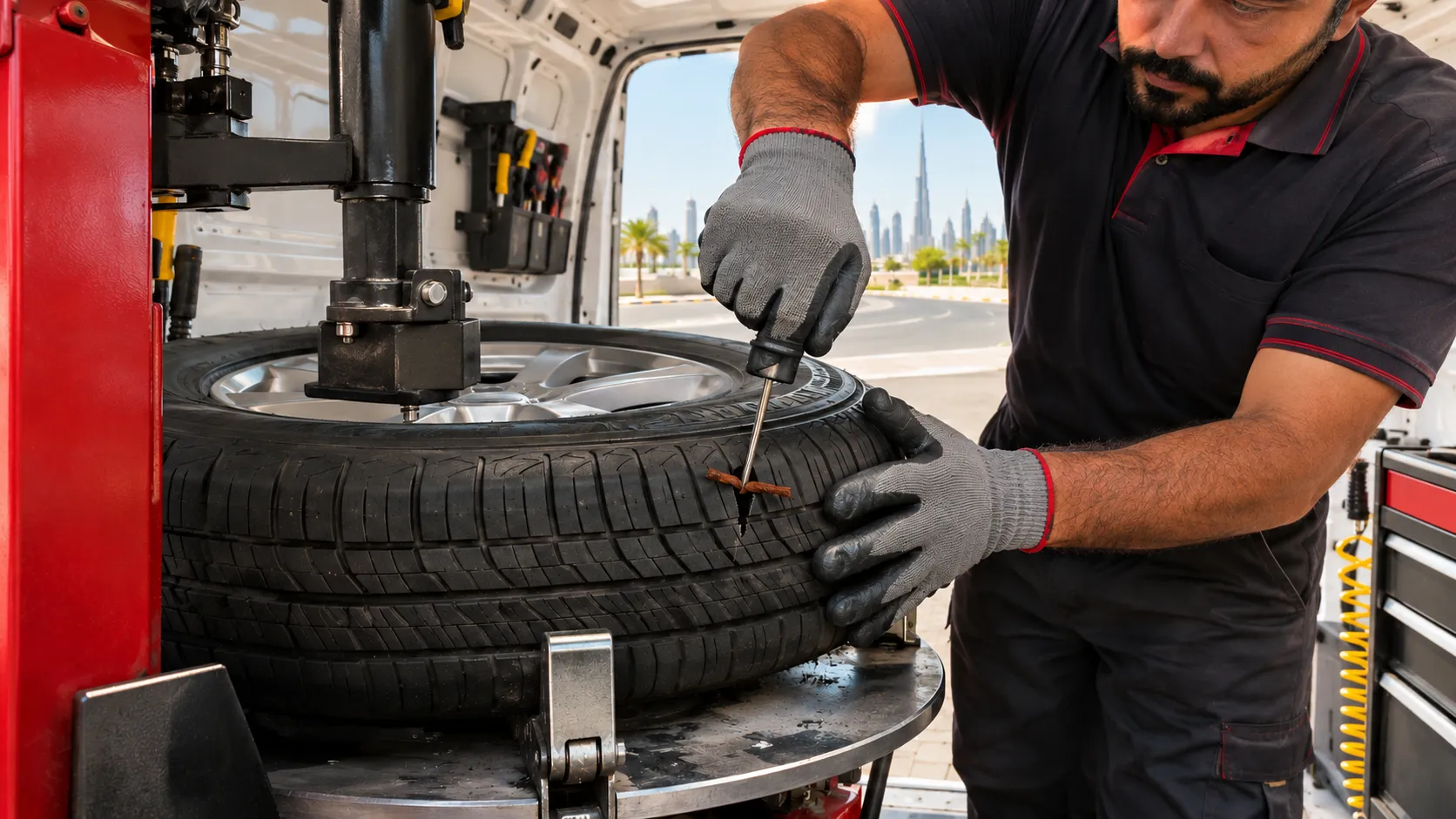
The foam matters if you get a puncture. A proper plug-patch repair needs a clean inner liner, so the technician has to carefully cut away a small section of foam around the injury before preparing the surface. Sealant from a repair kit soaks into the foam and makes the job much harder. If you have a foamed tyre, call us before you use sealant.
Tesla tyres in the UAE
Tesla is the EV I fit the most tyres on. Tesla-approved tyres carry a T0 (or T1, T2) marking on the sidewall, and many of them include acoustic foam. Model 3 and Model Y owners also need to know that some trims come with 20 or 21-inch wheels, where tyre choice is narrower and prices higher.
| Model | Common sizes seen | Notes |
|---|---|---|
| Model 3 | 235/45 R18, 235/40 R19, 235/35 R20 | Some performance trims run staggered sizes on 20s |
| Model Y | 255/45 R19, 255/40 R20, 255/35 R21 (rear 275/35 R21 on some) | Heavy; check XL/HL load index |
| Model S / X | Various 19–22 inch | Expensive sizes; stock can be limited |
Can you fit normal tyres on an electric car?
Yes, as long as the size, load index and speed rating meet or exceed the car's specification. Nothing in the law requires a tyre labelled 'EV'. The compromise is usually in noise, range and wear. A good touring tyre with the right load rating will do the job, but you'll probably hear it more and lose a few percent of range.
For most owners, I suggest EV-specific or car-maker-approved tyres on the axle that matters most for comfort, ideally all four. If budget is tight, a quality XL touring tyre is a reasonable alternative. What I'd avoid is the cheapest standard-load tyre in the size; that's the one choice that can actually be unsafe.
Pressure, range and summer heat
EV makers usually specify fairly high tyre pressures, partly for efficiency and partly to carry the weight. Running a few psi low costs you range you'll notice on the dashboard, and on a heavy car it also builds heat in the sidewall faster. In a UAE summer that is worth taking seriously.
Check cold pressures every two weeks, not just when the TPMS complains. If you regularly do long runs between Dubai and Abu Dhabi, set them before you leave, not at a service station halfway when the tyres are hot. And don't be tempted to soften them for comfort; the ride on 20 and 21-inch wheels is firm by design, and lower pressure won't change much besides wear and range.
Mobile fitting for EVs
EVs suit mobile fitting well because they are often parked at home on a charger. We lift EVs only at the manufacturer's jacking points, using pads that protect the battery pack, and we torque wheels by hand to the specified figure. TPMS sensors on most EVs are direct and sometimes need a relearn after rotation, which we handle on site.
Frequently asked questions
Do electric cars need special tyres?
They don't legally need tyres labelled 'EV', but they do need tyres with the right load index, often XL or HL, because they are heavier. EV-specific tyres also reduce noise, protect range and resist torque wear better.
Why do EV tyres wear out faster?
Electric cars are heavier and deliver full torque instantly, so the driven tyres scrub more on acceleration. Driving style and summer heat make a big difference, and rotating every 6,000–8,000 km helps.
What does T0 mean on a Tesla tyre?
T0 is Tesla's original-equipment approval marking, showing the tyre was developed to Tesla's specification. Variants such as T1 or T2 indicate later approved versions.
Can tyres with noise foam be repaired?
Yes, a puncture in the central tread can still be repaired with a plug-patch. The technician removes a small section of foam around the injury to prepare the inner liner, so avoid using tyre sealant first.
What is an HL tyre?
HL stands for high load, a newer category of reinforced tyre that carries more weight than an XL tyre of the same size. It is used mainly on heavy EVs and large SUVs.
Can you change EV tyres at home in Dubai?
Yes. We fit tyres on EVs at homes, offices and car parks across Dubai, Sharjah and Abu Dhabi, using the correct jacking points to protect the battery and programming TPMS where needed.
Faisal Imram has spent eight years fitting, repairing and diagnosing tyres across the UAE — from villa driveways in Arabian Ranches to hard shoulders on Sheikh Mohammed Bin Zayed Road. He leads the mobile tyre team at 800Sayara and writes our guides from what he sees on the job every day. More from Faisal.